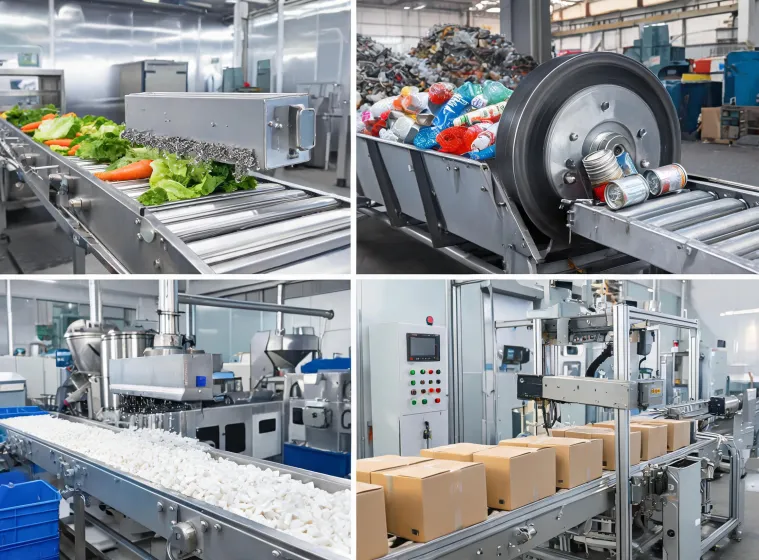
Food and packaging lines
Magnets may sit near conveyors, chutes, hoppers, and inspection points where cleaning access and stainless housings are as important as magnetic strength. Bunting helps teams consider washdown, product flow, foreign material risk, and maintenance routines before settling on a configuration.
Discuss line conditions
Recycling and material recovery
Mixed streams create impact, abrasion, and inconsistent burden depth. The useful magnet choice depends on belt speed, particle size, separation distance, ferrous load, and how operators will remove captured material during a busy shift.
Plan a recovery review
OEM equipment builders
Designers often need a magnet that fits a fixed envelope, holds through vibration, and can be installed without complicating service. Bunting can compare bare magnets, pot magnets, channels, and custom assemblies against the machine layout.
Review a drawing
Plastics and bulk handling
Pellets, powders, and granular materials make magnet placement a flow problem as much as a material problem. Temperature, bridging, dust, cleaning frequency, and contamination tolerance should guide grate, plate, and drawer-style discussions.
Share a process note
Fabrication and workholding
Fixtures, jigs, and shop aids need repeatable holding behavior without damaging finished surfaces. Application support can narrow choices by contact area, release method, part weight, surface condition, and operator handling preferences.
Compare holding options
Electrical and sensor applications
Position sensing and compact assemblies may require stable fields, tight dimensions, and predictable orientation. Bunting helps buyers document magnetization direction, coating, tolerance expectations, and packaging notes for repeatable supply.
Clarify field needs