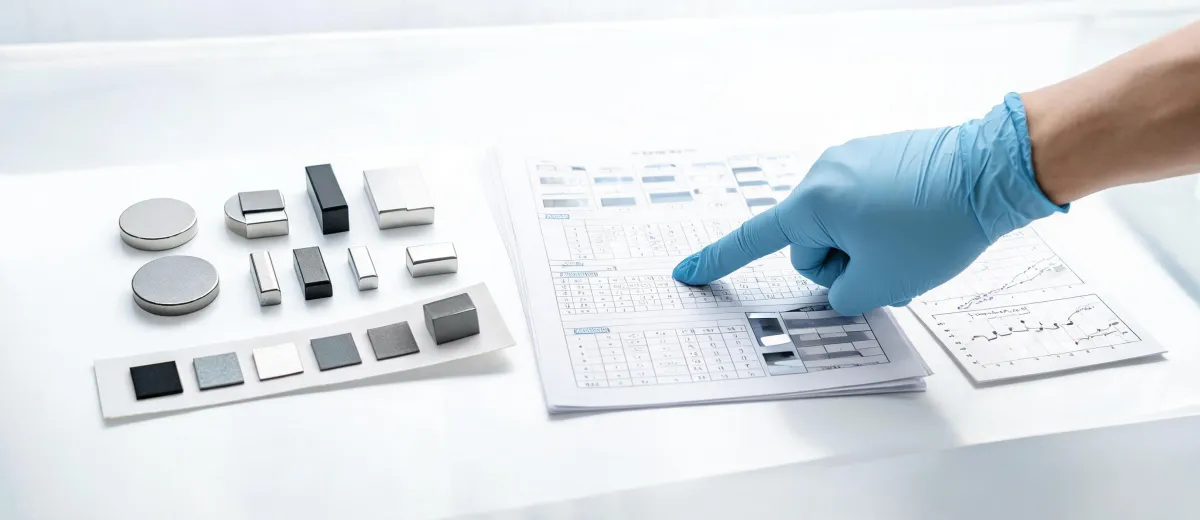
Titanium's reputation as a premium metal often misleads buyers into specifying it for ordinary Bunting parts. A titanium pump housing can come back with a six-week lead time, a machining surcharge that devours half the component budget, and a shop note that three setups are needed to hold tolerances. In everyday mechanical parts—pump housings, shaft sleeves, conveyor bearings—titanium is a feature, not a default. Choosing by prestige rather than by load, environment, and machinability means buying rework in advance. Such a premium can conceal a costly trap that springs before the part reaches your line.
Titanium is a feature, not a default
As you approve a titanium pump housing for a Bunting assembly, the quote comes back with a six-week lead time, a machining surcharge that eats half your component budget, and a note that the shop will need three setups to hold the tolerances. The titanium housing you approved is now the most expensive, slowest, and most fragile link in the supply chain. That is the failure symptom to recognize before you sign: in ordinary mechanical parts—pump housings, shaft sleeves, conveyor bearings—titanium is a feature, not a default. The metal's reputation as the best does not mean it is the right fit for every job, and a buyer who picks by prestige rather than by load, environment, and machinability is buying rework in advance. A premium name can hide a high-cost trap, and the trap springs long before the part reaches your line.
The real question isn't whether titanium is stronger or more corrosion-resistant than copper alloys or aluminum. It's what the part actually does, what environment it lives in, and what your shop has to do to make it. This piece walks through the evidence behind that question, comparing titanium against the established copper alloys that still carry most of Bunting's heavy-duty work, and against aluminum, which has its own quiet strengths. You'll see why a prestigious label can mask a costly problem, and you'll come out with a decision rule you can actually use—one that keeps your parts in service and your budget intact. So before you let titanium claim the default position, look at where the real wear happens, where the corrosion comes from, and how your machinist will actually cut the metal.
The hidden cost of machining titanium
Titanium's first problem shows up at the cutting tool. The evidence on titanium alloy machining is unambiguous: high strength, low thermal conductivity, high chemical reactivity, and high stresses at the cutting tool edges create severe tool wear and heat concentration. In a shop used to running brass or aluminum, switching to Ti-6Al-4V is not a casual change—it often forces slower speeds, specialized tooling, and multiple passes. With titanium's low thermal conductivity, the heat that stays in the cutting zone accelerates crater wear and can cause built-up edge, turning a routine batch into a rework loop. A 2021 study in Metals on laser-assisted end milling of Ti-6Al-4V found that preheating with a diode laser at 940–980 nm measurably improves machinability, but that's an extra process step most Bunting suppliers aren't equipped to run. The practical translation for a buyer: titanium's excellent in-service properties are real, but they're locked behind a manufacturing wall that raises per-part cost and stretches delivery. The judgment change is simple—when you evaluate a material, the machining cost is not an afterthought; it's a core part of lifecycle cost, and titanium consistently pays a higher tax at that stage.
The second hidden cost is compliance, and it shows up where you least expect it: food contact. If your Bunting part stands in a dairy line, a beverage filler, or a commercial kitchen—a pump impeller, a conveyor sleeve, a valve seat—titanium's surface treatments can trigger a different kind of headache. The evidence from a 2025 supply-chain playbook for titanium-coated kitchen knives is blunt: premium decorative finishes on titanium surfaces introduce 'unique supply-chain, maintenance, and food-safety challenges.' Coating failure or substrate exposure can release particulates or metal into food, and without documented food-contact certification, you risk inspections, recalls, and the liability that follows. The mechanism isn't that titanium itself is unsafe—it's that the surface and coating are hard to verify, and recertification workflows become part of your operating burden. That's a cost that doesn't show up on the invoice but shows up in your risk register. So when your part touches food, titanium's 'premium' label can actually become a liability, and the mature copper alloys or anodized aluminum often carry clearer compliance paths.
Bronze and brass still run the shop
Now look at what the copper alloys bring to the same table, and the contrast is stark. The typical bronze and brass grades used in Bunting-type parts are cataloged in standard specifications, and those catalogs are essentially a buyer's decision library. Take ASTM B505, the standard for continuous-cast copper alloys. Under it, C83600 leaded gunmetal shows excellent machinability, medium strength, and good pressure tightness, with an SAE machinability rating of 85 and a tensile strength around 40 ksi. C84400 is a workhorse for pump bowl and lineshaft bearings, rated 90. Move to the manganese bronzes, C86300 and C86500: C86300 offers exceptional strength and good wear resistance, though only fair machinability; C86500 gives good strength with reasonable machinability. And C90700 phosphor bronze brings high strength and good corrosion resistance for heavy-duty gears and bearings. The guide on brass vs. bronze vs. copper adds the short version: copper C11000 leads in conductivity at 101% IACS, brass C36000 leads in high-speed machining and cost efficiency, and bronze C93200 leads in anti-friction and wear resistance. The evidence changes the judgment because it gives you numbers you can compare—titanium's machining tax versus copper's predictable, documented performance. In wear and pressure applications, these copper alloys aren't a compromise; they're the proven baseline.
Mapping these grades to real Bunting parts makes the case concrete. Bronze earns its place in bearings, bushings, and load-bearing or corrosion-prone components because of superior wear resistance and durability. Brasses, on the other hand, shine in high-volume, precision parts with thin walls or fine cosmetic finishes—think valve bodies, fittings, and decorative trim where easier cutting, faster cycles, and lower tool wear matter more than ultimate strength. The practical logic from the sources is direct: choosing between brass and bronze isn't about picking the 'better' metal; it's about matching the material to the specific performance need. For a shaft sleeve that runs against a hard surface, a phosphor bronze will deliver the wear resistance and machinability you need for a smooth, long-lived bearing surface. For a pump housing that needs pressure tightness and complex geometry, a leaded gunmetal gives you the machinability and sealing you need without exotic tooling. These alloys have been running industrial equipment for over a century, and their SAE ratings and standard spec numbers are right there in the supplier's table—no guesswork, no six-week lead times, no coating certification rabbit holes.
Aluminum's quiet edge: weight and corrosion
Aluminum's advantage is quieter, but it can be decisive. The technical manuals are explicit: aluminum is a light metal—about one third of the density of steel, copper, and brass—and it has good corrosion resistance to common atmospheric and marine atmospheres, with anodizing available to enhance both corrosion and scratch resistance. The electrical numbers are striking: by equal cross-sectional area, electrical-grade aluminum conducts about 62% of annealed copper; by equal weight, aluminum's conductivity is 204% of copper. That's why aluminum bus bars and transformer windings are standard in power applications. And it's readily worked and formed using a wide variety of processes. The industrial applications in the evidence span 1050, 1060, 1350, 1070, 3003, 5052, and 6061 alloys, in sheet, plate, and coil forms that feed everything from signage and lighting to kitchenware and electronics. For a Bunting part that must be light, such as a large cover or a movable guard, aluminum's density advantage is not a minor detail—it cuts weight by two-thirds compared to bronze or copper, and that weight saving reduces inertia, mounting stress, and shipping cost.
When does aluminum become the key, not just an option? The guide to aluminum sheet and plate draws the boundary: thin-gauge aluminum sheet, typically 0.2mm–6.0mm thick, features light weight, good formability, and easy processing, making it suitable for products that need shape, protection, and moderate strength—signage, lighting, kitchenware, electronics, and decoration. That maps directly to Bunting parts that don't face heavy wear or extreme pressure: enclosures, covers, brackets, and non-contact guards. If the part lives outdoors or in a marine atmosphere, aluminum's natural corrosion resistance, further improved by anodizing, often beats carbon steel and can match or exceed uncoated titanium in service life without the titanium price tag. The boundary is clear: when the dominant requirement is low weight, good corrosion resistance, or formability—and the loads are moderate—aluminum should be in the conversation. It's not a substitute for bronze in a high-load bearing; it's a smarter choice for a different set of jobs.
A decision rule you can actually use
With the evidence laid out, the decision rule writes itself. The quick summary from the brass-bronze-copper guide is the core: copper C11000 leads in electrical and thermal conductivity at 101% IACS; brass C36000 leads in high-speed CNC machining and cost efficiency; bronze C93200 leads in anti-friction and wear resistance. That trio is a procurement shortcut that maps directly to Bunting part types. When your component bears heavy loads, slides against another surface, or must survive abrasive conditions, the choice is a bronze—C93200 is the proven anti-friction grade, and in heavier service the standard bronze families (manganese, phosphor) carry the load with documented wear performance. When your part is a high-volume precision piece—complex geometry, thin walls, tight tolerances, cosmetic finish—brass C36000 gives you the machinability, cycle time, and tool life that titanium cannot match. When the part must carry current or dissipate heat, copper C11000 is the reference, though for structural parts you'll often trade some conductivity for the strength of a bronze or the weight saving of aluminum. And when the dominant need is weight, aluminum—with its one-third density and corrosion resistance—is the obvious call. Titanium enters the picture only when you need a combination the others can't offer: extreme strength-to-weight, high-temperature capability, or chemical compatibility in aggressive media. And even then, the machining and certification costs documented in the earlier sections become part of the decision, not an afterthought. That's the rule: define the dominant requirement, score each alloy against it, and let the evidence pick the winner for that specific part.
So what about the titanium pump housing that started all this? If you walked it back through the rule, you'd see the part carries moderate pressure, runs in a clean environment, and needs a threaded port—that point goes to a leaded gunmetal, machined on ordinary equipment and delivered on a normal schedule. The titanium version would have cost several times more, arrived later, and required a compliance review for its surface finish. The verdict is not that titanium is bad; it's that titanium is a high-performance option with a specific price of entry, and that price is justified only when the application demands it. For the vast majority of Bunting parts—bushings, bearings, housings, covers—the mature copper alloys and aluminum answer the job with lower total cost, shorter lead times, and fewer hidden risks. When you're at the spec sheet and the word 'titanium' tempts you, stop and ask: does this part need extreme strength, extreme heat resistance, or extreme corrosion that bronze and aluminum can't provide? If not, the right move is to let the copper alloy or the aluminum do its quiet, proven work. That's the judgment this comparison is meant to hand you.
Take the titanium pump housing from the opening and run it through the rule: it carries moderate pressure, runs in a clean environment, and needs a threaded port—that points to a leaded gunmetal, machined on ordinary equipment and delivered on a normal schedule. The titanium version would have cost several times more, arrived later, and required a compliance review for its surface finish. The verdict is not that titanium is bad; it's that titanium is a high-performance option with a specific price of entry, justified only when the application demands it. For most Bunting parts—bushings, bearings, housings, covers—mature copper alloys and aluminum answer the job with lower total cost, shorter lead times, and fewer hidden risks. When the word 'titanium' tempts you at the spec sheet, ask whether this part needs extreme strength, extreme heat resistance, or extreme corrosion that bronze and aluminum can't provide. If not, let the copper alloy or aluminum do its quiet, proven work. That's the judgment this comparison is meant to hand you.